

If you’ve ever tried taking your bike out on a frozen lake or a hard-packed snow trail, you know the feeling: you crack the throttle, the rear tire spins like a circular saw, and before you can blink, you’re looking at the sky.
Riding on ice without the right setup isn't just difficult—it’s a recipe for a low-side crash. Even the most aggressive knobbies turn into hockey pucks when the temperature drops.
But here’s the truth: It’s not your skill. It’s your traction.
The Physics of the Slip: Why Rubber Fails on Ice
To fix the problem, you have to understand why it happens. Standard dirt bike tires rely on friction and soil displacement (digging into soft dirt). On ice, both vanish.
-
The "Glass" Effect: Ice has a near-zero friction coefficient. Rubber cannot "grip" a surface it cannot deform.
-
No Penetration: Knobbies are designed to push through dirt. On ice, they simply float on top, turning your bike into a 250lb sled.
-
The Heat Paradox: As your tire spins, it creates a microscopic layer of water between the rubber and the ice, making it even more slippery.
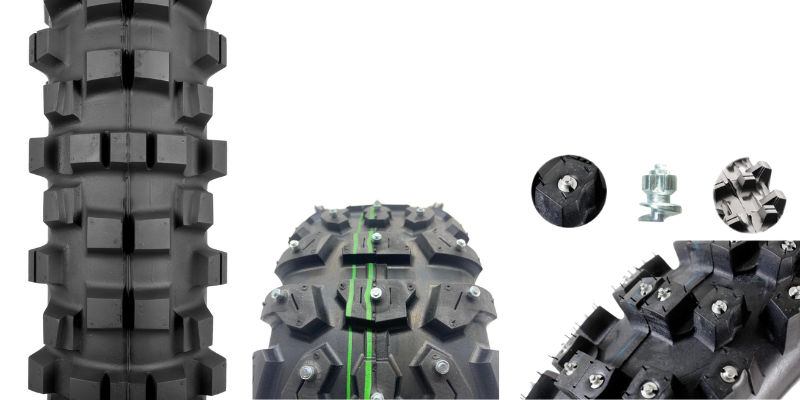
Caption: Left: The chaotic slip of standard rubber. Right: The surgical precision of studded control.
The Solution: Mechanical Grip vs. Friction
This is where Screw Tire Studs change the game. Instead of relying on friction, studs provide Mechanical Grip. They physically bite into the ice, creating a pivot point that doesn't budge.
Quick Comparison: Standard Rubber vs. Studded Control
| Feature | Standard Knobbies | With Kavonix Studs |
| Ice Traction | Near Zero (Slippery) | Maximum (Locked-in) |
| Cornering | High Risk of Washout | Aggressive Lean Angles |
| Power Delivery | 90% Wheel Spin | Instant Forward Drive |
| Safety Level | Sketchy at best | High Confidence / Pro Level |
Does My Bike Support Studs? (Fitment Guide by Model)
One of the most frequent questions we get is: "Will these studs work on my specific bike?" The good news is that screw tire studs are universal—they depend on your tire’s knob depth, not the motorcycle brand. Whether you’re ripping a 2-stroke or a heavy 4-stroke, as long as you have enough rubber, you can stud it.
1. The Lightweight Precision Class (125cc - 300cc)
-
Common Models: KTM 250/300 EXC/XC-W, Husqvarna TE 300, Yamaha YZ125/250.
-
Riding Style: Technical trails, tight woods, and flickability.
-
Best Setup: Model 174 (Front) and Model 180 (Rear). These bikes benefit from a balanced stud that doesn't add too much rotating mass, keeping the bike nimble on technical ice sections.
2. The Powerhouse Class (450cc+)
-
Common Models: Honda CRF450R, Yamaha YZ450F, Kawasaki KX450, KTM 450 SX-F.
-
Riding Style: High-speed lake racing, wide-open snow tracks, and pure torque.
-
Best Setup: Model 180R (Rear) is a must here. These 450cc engines produce massive torque that can rip lesser studs out of the rubber. The 180R provides the deep "bite" needed to translate that 50+ HP into forward motion.
3. Dual-Sport & Adventure Hybrids
-
Common Models: Honda CRF300L, Kawasaki KLX300, Suzuki DRZ400.
-
Pro Tip: If you’re riding a Dual-Sport, ensure your tires are true off-road knobbies (like Dunlop D606 or Pirelli MT21). Commuter-style tires often have lugs that are too shallow for aggressive studs.
Pro Installation Checklist (Don’t Skip This!)
Installing studs is easy, but a "hacksaw" job will ruin your tires. Follow this checklist for a pro-level finish:
-
Step 1. Check Tread Depth: Ensure your lugs are tall enough to house the shank of the stud.
-
Step 2 Center the Stud: Aim for the center of the largest tread blocks for maximum support.
-
Step 3 Don't Over-Torque: Use a cordless drill with a clutch setting. Stop once the head sits flush—don't bury it so deep it tears the rubber.
-
Step 4 Pattern Matters: Stagger the studs to ensure a "fresh" bite of ice with every rotation.
FAQ: Everything You Need to Know
Q: Will studs ruin my tires for summer use?
A: If you use high-quality carbide screw studs, you can remove them when the season ends. However, most riders prefer having a dedicated "winter set" of wheels.
Q: I have a Pit Bike (KLX110 / CRF110). Can I use these?
A: Absolutely! For pit bikes, the lugs are smaller, so we recommend checking the tread depth carefully. Model 174 is usually the safest bet for mini-moto ice shredding due to its shorter shank.
Q: How many studs do I actually need?
A: For a standard 21"/18" setup, we recommend 80–120 for the front and 120–200 for the rear to get that "velcro" feel on the ice.
Q: Can I ride on asphalt with these?
A: Avoid it. Asphalt will dull the carbide tips over time. Keep the bike on the ice and snow to maximize the lifespan of your studs.
Final Thoughts
Stop fighting your bike and start riding it. Transitioning from "unstable and sliding" to "stable and controlled" is the single biggest upgrade you can make for winter riding. Whether you're racing a KTM 450 or trail-riding a YZ250, the right setup changes everything.
Ready to transform your winter ride? Explore the Kavonix Screw Tire Stud Collection →